Some predictions for 2025

Last January, I wrote a series of predictions for 2024, and had mixed success. So, I’m going to try again in 2025 – let’s see how these work out.

Twitter/X won’t become an ‘everything app’

I’m recycling this prediction from last year, as it didn’t happen then, and I doubt it’ll happen in 2025 either. Elon Musk is apparently going to co-lead Donald Trump’s ‘Department of Government Efficiency’ or ‘DOGE’, the name presumably chosen because Elon’s sense of humour hasn’t caught up with his age. So he’ll have more on his plate, and at a time when large numbers of people have left X which will affect advertising revenue. Remember that a lot of the money Elon used to buy Twitter (as-was) was loaned, and he’ll need to start paying those loans back at some point. Having briefly looked at Twitter again this morning, the adverts I saw were for mostly unknown companies, some of which had Community Notes attached to them basically stating they’re a scam. So that’s going well.

I still don’t think Elon will sell X this year, but I expect it’ll largely stagnate again.

Donald Trump will be terrible in ways we haven’t foreseen

Trump has already outlined what he plans to do when he’s back in office as US President. I expect some of those policies to be weakened or dropped entirely; even though the Republicans once again control both the Senate and House of Representatives, but the recent deal to avoid a government shutdown suggests they may not always vote as a contiguous block. And not necessarily in the way that Trump wants either.

But I also expect that there are things we don’t yet know about that Trump will react to in the worst way imaginable.

Trump and Musk will have a public fall-out

Musk’s control of X, and massive donations in the run-up to the election seemed to have allowed him to curry favour of Trump – hence Musk being allowed to co-lead DOGE. But I also expect that their egos will clash, and only one of these two people will be President. What the impact of this will be remains to be seen but I can’t help but see Elon as something of an Icarus character at present.

Labour will do poorly in local elections

There’s a likelihood of local elections on the 1st May 2025, although most of these are for county councils which the government is proposing to abolish, so some areas may have elections after all. Labour’s popularity has dive-bombed since winning the 2024 general election, as the government has introduced some unpopular policies. It’s a tactic that may pay off – the next general election may not be until 2029. But I imagine some people who voted Labour last time may be tempted to vote for other parties. And most of the council seats being defended are currently held by the Conservatives.

Reform UK, the party led by Nigel Farage, managed to return five MPs last year and is hoping to make gains in the local council elections too. And there’s a possibility of a massive cash injection from Musk to give them more resources to do this. I can see Reform putting up a strong challenge to Labour and the Conservatives in some seats. Whether they’ll win any, or just split the vote, remains to be seen.

There won’t be a General Election in 2025

Okay, this is a very easy prediction to make. General elections in the UK need to happen approximately every five years, and so the next one isn’t scheduled to 2029, as mentioned above. But governments can call early ones, and indeed this happened in 2017 and 2019.

The only reason why I’m including it here is because 3 million people have (apparently) signed a petition calling for a general election, and it’s currently the most popular petition. There will be a debate about this on Tuesday 6th January, apparently, but most likely in Westminster Hall and not the House of Commons.

The overall situation in the Middle East will improve

I don’t know if there will be a ceasefire in Gaza this year; I hoped for one last year, and it didn’t come to pass. But the situation in Syria is, at long last, encouraging, and I hope that the region as a whole stabilises.

Well, we’ll see what happens at the end of the year.

Reviewing my 2024 predictions

So, back in January, I made seven predictions about events that would take place in 2024. So, seeing as there’s just a few days left in 2024, let’s see how I did:

Twitter/X won’t become an ‘everything app’

Remember when Elon Musk took over Twitter in 2022 that it would become X, the ‘everything app’? I predicted that this wouldn’t happen in 2024, and, so far, it hasn’t. I don’t use X anymore, although I keep my account live, and upon logging in to write this, the only new things I could see were some kind of job search, and Grok, its AI ChatGPT competitor. This is a far cry from apps like WeChat.

One of the few things that Elon Musk is actually good at is over-promising and under-delivering, so this isn’t surprising. But X was supposed to be able to offer all sorts of new functionality, including financial services, if Musk were to be believed.

Labour will win the 2024 General Election

Yes, they did. But any other result was unlikely, to be fair. It has been a rocky ride since then, with Labour front-loading their time in power with unpopular policies like the limits on the Winter Fuel Payments. However, with the next general election not due until 2029, there’s time to re-build.

What I didn’t expect was how well the Liberal Democrats ended up doing in the election. Their tactics of concentrating on seats mainly in the south west massively paid off, with one of their best ever results.

There will be a ceasefire in Palestine

Nope, sadly. We’re over a year in now, and fighting continues. The recent regime change in Syria is a potential bright spot though.

But the war in Ukraine will continue

Yes, sadly. But it’s notable that things are not going well for Russia, with forces being drafted in from North Korea. That’s because Russia is rapidly running out of people fit to fight on the front in Ukraine, as shown by its massive fall in unemployment.

Energy prices in the UK will start to fall again

They did, and then they started going back up again in October, by around 10%. Overall, Brits are still paying significantly more for energy than we were a few years ago, although there are at least a wider range of tariffs available now.

The UK will do okay at Eurovision this year

No, we didn’t really. We came 18th out of 25th, with all the points coming from professional juries and none from the voting public. I was hoping we would do better, with Olly Alexander representing us, but I don’t think it was the best song.

Trump won’t win the US Presidential Election

Oh dear, a big no. Honestly, in the run-up to the election I though Kamala Harris had it in the bag, so I was surprised and disappointed that she didn’t win.

So, overall, half of my predictions were (mostly) correct. Which isn’t bad, although clearly there were some that I wanted to be correct but weren’t. Oh well.

Sky Follower Bridge

A screenshot of the Sky Follower Bridge home page

Last week, the social network Bluesky surpassed 14 million users. Users seem to come over from Twitter/X in waves – essentially whenever its excessively wealthy and over-impulsive owner does something to make it even worse. If you’re setting yourself up on Bluesky, and want to find the people that you were previously following on Twitter, then Sky Follower Bridge can help you.

Unlike some tools that were around a couple of years ago for finding people on Mastodon, Sky Follower Bridge is a browser extension. This means that it doesn’t use Twitter’s API, as such apps have generally been shut down pretty quickly, and is a clever way of side-stepping this issue. That does, however, mean that you’ll need to use a desktop browser to find your followers. Extensions are available for Chrome and Firefox; I used the Firefox version, but the Chrome extension has been updated more recently.

Finding your follows

Once the extension is installed, you’ll need to go to the page on Twitter/X that lists the accounts you follow, and then you activate the extension by clicking its toolbar button. It’ll then analyse who you are following to see if it can find a corresponding Bluesky account.

Some people will have put their Bluesky usernames in their Twitter/X bios, so Sky Follower Bridge should detect these. It’ll also look for matching names and usernames and suggest Bluesky users on this basis. This does mean that, if you follow someone with quite a common name, such as, oh, I don’t know, ‘Neil Turner’, it may suggest a different user on Bluesky with the same name.

Although I’ve been on Bluesky for just over a year, Sky Follower Bridge found 18 accounts that I used to follow on Twitter who are also on Bluesky. However, not all are active; it seems like quite a few signed up, tried it and then haven’t returned. Still, if you’re making the move off Twitter and want to stay connected with your previous followers, this is a good tool to use. And if you’re not already following me on Bluesky, here’s my profile link.

Joining all the Brits and Brazilians on Bluesky

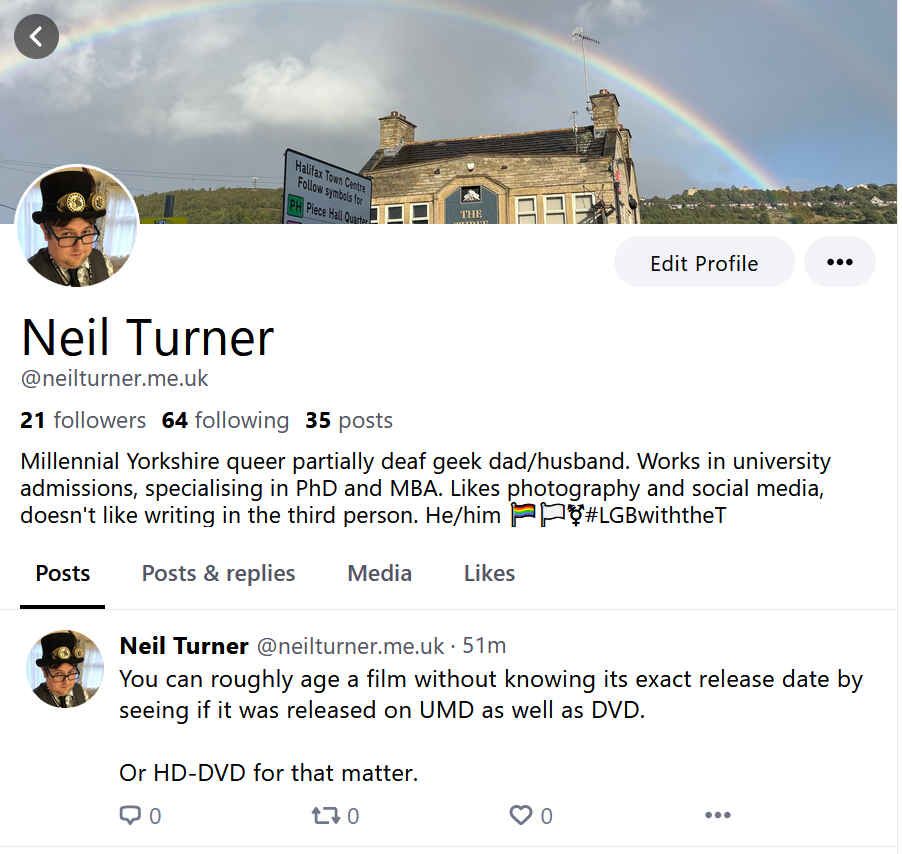
The tl;dr version of this post is that I’m now considering Bluesky to be my primary public social media presence, with Mastodon a close second and Threads a distant third, and here are the links to my profiles:

Last month, Elon Musk basically tried to incite civil war in the UK on Twitter (which he calls ‘X’). This seems to have been the last straw for many Brits who were still active over there and who don’t consider themselves to be right-wing, and so there’s been another exodus. This time, Bluesky seems to have been the main destination, and so I’m now reconnecting with lots of people that I used to follow on Twitter before I basically quit almost two years ago in November 2022. Since then I’ve been mostly hanging out on Mastodon.

Now, I like Mastodon; especially its decentralised nature and that many servers are run by the community with donations. It’s also got some good and mature third-party clients like Ivory, which I use. But it still feels like a niche social network that attracts a more technical audience. And it’s notable that, given the choice between Mastodon, Bluesky and Threads, most Brits leaving Twitter haven’t chosen Mastodon.

The Brazilian Twitter exodus

Over the past couple of days, there’s been another mass exodus from Twitter, this time in Brazil. However, this is because Twitter is now blocked in Brazil. In a nutshell: Brazil’s previous right-wing president, Jair Balsonaro, was ousted in an election; there was an attempted coup by his supporters, and then a Brazilian Supreme Court judge demanded that Twitter suspend the accounts of those suspected of being involved in the coup whilst they were under investigation. Instead of complying, or even challenging the court order, Elon Musk closed Twitter’s office in Brazil and sacked its staff. So, the supreme court judge gave Twitter an ultimatum to appoint a representative in Brazil; Twitter refused, and so it’s now blocked. As in, the whole web site is inaccessible from within Brazil.

Consequently, Twitter users in Brazil have been looking for a new home, and most seem to have landed on Bluesky (although some have gone to Mastodon too).

If these statistics from Statista are right, then Brazil made up the sixth biggest audience on Twitter, just behind the UK. Which means that Elon has alienated two of his top ten biggest markets in the space of a month.

Oh, and it gets worse. It turns out that Brazil was home to many large fan accounts on Twitter; many of these posted in English and so it wasn’t immediately obvious that they were based there. So they’re gone from Twitter too. At this rate, Twitter is going to become like the alt-right social network Gab, just with some brands wondering where all their engagement has gone.

Galaxy brain

Before his purchase of Twitter, Elon Musk had a reputation for being a forward-thinking successful entrepreneur. Tesla was a pioneer in all-electric cars, SpaceX has contracts with NASA, and his Starlink network allowed people living in remote areas to access satellite broadband internet.

But he’s completely ruined Twitter. I’m not sure whether it’s some kind of galaxy-brained scheme that mere mortals like myself are unable to comprehend, or whether he’s actually not that intelligent but has lots of money to throw around to see what sticks. Or somewhere in the middle. Either way, he seems to keep making unforced errors that seems to make no kind of sense business-wise. It’s worth noting that, despite being probably one of the world’s richest people, he took on a lot of debt to buy Twitter, and those loans will be accruing interest. It can’t be long before Twitter goes bankrupt, can it?

As for my Twitter profile? It still exists, mainly so that I don’t lose my username. But my profile is private, and I’ve deleted my avatar and background. I haven’t had the Twitter app on my phone for over 18 months now.

Business models

My only worry about Bluesky is its business model. In the long term, how is it going to make money? Are we going to start to see adverts, like on most other social media? Will there be a premium tier?

On Mastodon, I pay small monthly contributions via Patreon and Ko-Fi to the overall project and server owner respectively, and that suits me well. And Threads is part of Meta. I’m assuming Blueksy is backed by venture capital money, but at some point it’s got to be able to make money on its own terms. I just hope it’s done in a way that won’t massively alienate its user base.

Some predictions for 2024

An AI-generated image of some felt art of a fortune teller with a crystal ball that says 2024 on it

Now that the year has started, I’m going to make some predictions for the rest of 2024. If only because it’ll be interesting to look back in a year’s time to see what actually happens.

Twitter/X won’t become an ‘everything app’

When the overly impulsive billionaire took over Twitter, he announced that it would become an ‘everything app’, like WeChat is in China. Essentially, he’s using his Twitter acquisition to realise his late 1990s dream for x.com, which would offer a huge variety of financial services.

But Musk also has a track record for over-promising and under-delivering. Look at the ‘full self driving’ mode offered on his Tesla cars, which, well, isn’t. His other firms, like The Boring Company, have also scaled down their lofty plans. So I don’t expect X/Twitter to offer much more than it does now by the end of the year.

I expect the core social media aspect of X/Twitter to continue to whither away over the year, thanks to declining user interest and lower advertising revenue. However, I still expect it to be around by the end of 2024 – I don’t think Musk is ready to throw in the towel and shut it down, or sell it at a massive loss.

Labour will win the 2024 General Election

We know that there will be a General Election in the UK this year, although not precisely when it’ll happen. Labour consistently leads in the polls, and has had some unprecedented by-election victories. I don’t think we’re looking at a repeat of 1997, when Labour won by a landslide, but I would expect a comfortable majority. How much change a new Labour government would be able to make partly depends on when the election is, but I’m not expecting the state of the country to massively improve by the end of the year.

Oh, and Sadiq Khan will win a third term as Mayor of London.

There will be a ceasefire in Palestine

Hamas’ deadly attack on Israel on the 8th October has to be condemned, but Israel’s response has been despicable with thousands of innocent civilians losing their lives. I expect Israel to find itself increasingly isolated on the world stage and a ceasefire will be inevitable by the spring of 2024. Unfortunately, I can’t see it being a route to lasting peace in the region, but any reduction in hostilities has to be better than this.

But the war in Ukraine will continue

I’m less optimistic about the war in Ukraine, which has been largely at a stalemate for the whole of 2023. Russia still intends to hang on to the territory that it has seized, including Crimea, whilst Ukraine hasn’t been able to make major advances. Meanwhile political issues in the USA mean that funding for Ukraine to carry on fighting isn’t guaranteed.

Energy prices in the UK will start to fall again

It will be a few days before we get official confirmation from the National Grid, but I’m calling it now: 2023 was the year renewables overtook fossil fuels as the largest contributor to British electricity generation. In the 12 years I’ve been running National Grid: Live at grid.iamkate.com electricity generation from fossil fuels has fallen from an average of 25.1GW to 10.2GW, while renewables have risen from 2.5GW to 10.8GW.

— Kate Morley (@kate) 2023-12-31T12:14:09.211Z

In 2023, the UK generated more electricity from renewable sources than from fossil fuels, for the first time. Whilst UK consumer energy prices went up by 5% on Monday, I anticipate that the cost of electricity will start to fall as more renewable power sources come online. The newly-operational Viking Link Interconnector means that we can trade electricity with Denmark, and the biggest wind farm in Scotland is now online.

That being said, there’s an imbalance in the UK as most wind power is generated in the north of England and Scotland, but the highest demand is in the south of England. And our energy grid doesn’t have capacity to move this, which means that some northern wind turbines have to be turned off and gas-fired power stations turned on – costing money and contributing to climate change. However, there’s been a big up-tick in home solar installations like ours which may help, albeit on a small scale.

The UK will do okay at Eurovision this year

In 2023, the Eurovision song contest was hosted in Liverpool. The 2022 winners Ukraine couldn’t host it safely due to the ongoing war, and the UK came second – our best result for over 20 years. And then despite what I thought was a good song from Mae Muller, we came second-from-bottom.

For 2024, Olly Alexander is representing the UK. As lead singer of Years & Years, I have some high expectations. I doubt we’ll win, but I would disappointed if we’re not mid-table. Of course, we haven’t actually heard the song yet.

Trump won’t win the US Presidential Election

Trump will almost certainly become the Republican Party’s candidate for president, but with two states banning him from their ballots, his campaign isn’t going well. I know Biden isn’t terribly popular, and wish he had stepped aside for someone younger like Kamala Harris, but Trump has made it pretty clear that if he wins (and manages to get a decent Republican Senate and House majority) then he will take the US down a path of authoritarianism that will take a lot of time to unpick. And whilst millions of Americans seem to be okay with this, I doubt it’s the majority.

We also don’t yet know what impact Trump’s legal issues will have, or whether the Federal Supreme Court will overrule Colorado and Maine’s bans. I didn’t think Trump would get elected in 2016, and so I have been wrong about this before, but I hope people’s experiences of 2017-2021 will guide them to vote against him again.

So these are my predictions for 2024. We’ll see at the end of the year whether they happen or not. Meanwhile, have a look at some other predictions from Terence Eden and Diamond Geezer.

Twittering the threads of the mastodontic blue sky diaspora

This month was something of a grim anniversary for those of us who used to call Twitter our home on social media, as it marked one year since Elon Musk took it over and basically ruined it.

In that time, many users have left for other platforms — mainly Mastodon, Bluesky and Threads. I too have left Twitter, or rather ‘X’, as Elon wants us to call it now, albeit with my account still technically active and a placeholder tweet.

For me, Mastodon is where I spend more of my time (I also use Facebook a lot, but that’s locked down so that everything is friends-only), but I have accounts on Bluesky and Threads. Bluesky seems to be where all the nice people from Twitter went, whilst on Mastodon I’m following mostly new people that I didn’t previously follow elsewhere.

As for Threads — I think I’ve posted there once but despite importing the accounts I follow on Instagram, it seems like the people I already follow there don’t use it much, so nor do I.

And yes, I’m having some nice interactions on Mastodon and Bluesky, but this recent post by Dan Sinker really resonates with me. Especially this:

One of the main topics of discussion on all three is how they’re not as good as Twitter, which is true. They are not as good as Twitter. But neither is Twitter. And the reality is that nothing will ever be as good as something that grew organically — largely through user-driven innovation — over the course of 15 years. Because, whether you knew it or not, so much of what we loved about Twitter was the work it took to become the thing we knew.

On the occasions that I do log into X/Twitter, I still see some people posting regularly, whilst others have gone to one or more of the other platforms. And the best analogy I can think of is when an event causes people to be displaced — war, famine and so forth — which results in some people staying put, and others seeking refuge in various different places.

Displaced people may gravitate to where they have existing connections. After all, if you have to move to a new place at short notice, knowing that there will be familiar people there to help you settle in may be some comfort in what would otherwise be a very stressful situation. For example, when Russia invaded Ukraine last year, a number of Ukrainians sought refuge in the UK where there was already a small Ukrainian diaspora; others went to nearby countries and some stayed put.

Similarly, when Twitter became too toxic for people, some may have chosen Mastodon because people they knew already had accounts there; whilst Mastodon took off in 2022, it has been around since 2016 and there were a series of smaller exoduses in response to changes to Twitter in the pre-Musk years. Some may also have preferred it because it had been around for longer and is a more mature platform, or liked the idea of federation and each instance having its own community.

For others, Threads will have made sense because of its links with Instagram; rather than signing up and having to search for people to follow, you could import your Instagram followers and have content to scroll through from day one.

Others will have followed their friends to Bluesky by being invited there, and may appreciate the invite-only status that it has at present which seems to be keeping out some of the nastier elements of Twitter.

Whilst this explains why some people have chosen one (or more) particular platform(s), it does mean that our friends are scattered across several places — there’s not yet one place that can amalgamate these different social networks into one feed. Mastodon does have an open and permissive API, and is part of the Fediverse, but Threads isn’t yet (although its a proposed feature) and Bluesky looks to be developing its own protocol instead. I have fond memories of TweetDeck, before it was bought by Twitter, offering a single feed with both tweets and Facebook posts in it. But its acquisition by Twitter resulted in gradual enshittification and such features were removed.

Maybe there will be some kind of super-app that will allow you to interact with your social media follows, regardless of which service they’re signed up — just like email. And maybe a post-Musk Twitter would be on there too; despite Musk’s lofty plans to turn X into some kind of everything app, I wouldn’t be surprised if he sells it on when it fails to become a financial services nexus. Something tells me that his ‘lol, whatever’ attitude to regulation is not going to sit well with the financial services regulators. But for now, we’ll have to make do with a series of smaller, more dispersed communities.

This post was originally posted on Medium.

Being more or less social

A screenshot of my profile on the Bluesky social network.

Good grief, has it really been almost 6 months since my last blog post?

I mostly dropped by to link out to a couple of additional social media profiles that you can follow, should you wish to. I appreciate that many people are leaving Twitter/X/whatever Elon Musk decides it’s called this week, and not everyone is leaving in the same direction.

Firstly, I’ve just signed up to Bluesky. It’s invite only at the moment, so I doff my cap to a work colleague who gave me her first invite. I’ve just made the one post there and I’ll see how I get on with it.

I managed to – eventually – get my account verified there, which is how I show as ‘@neilturner.me.uk’ and not a bsky.social address. It should have been straightforward, but over the years my DNS settings have seemingly got out of sync, and this has required some fixing. Hopefully everything works now.

And I’m on Meta’s Threads, which I joined on launch day back in August. Again, I’ve just made the one post there. It doesn’t look like many people that I followed on Instagram are active on Threads – my feed seems to basically be the same 5 people.

My primary social media presence is still on Mastodon. So, if you want to hear from me in between my massive gaps in blogging, that’s probably your best bet. I joined Mastodon back in November 2022, and I feel most-settled there.

Perhaps if Bluesky and/or Threads open up a bit more, I might cross-post things, but we’ll see.

Why I’ve sort-of quit Twitter

I’ve been a Twitter user since June 2006, apparently, and in that time there have been very few days where I haven’t been on it. It’s been a major source of both information, news and entertainment for me for over a decade.

I’m probably not your typical Twitter user, either. For a start, I generally don’t use the official Twitter app; instead, I prefer Tweetbot, a third-party client which had a ‘mute’ filter long before it became available to all Twitter users. And, barring tweets that I’ve muted, I try to read every tweet on my timeline; Tweetbot even remembers my ‘position’ in the timeline and synchronises this between devices. Typically, I would read about 500 tweets per day.

Reading tweets would start at breakfast (which is about 6:30am for me), with catch-ups at lunchtime, whilst commuting on the train, and before bed. In all, I would typically spend over an hour every day reading tweets.

It’s when I have spelt it out like this that I realise that my relationship with Twitter wasn’t really a healthy one. I had a hunch that I was probably spending too much time on Twitter, but, I found it entertaining and enlightening and it was a good way of passing the time.

Until it wasn’t.

I know I’m not the only person who was very disappointed with the outcome of the UK’s general election last month. But as a remain-supporting Labour Party member, it was pretty devastating. And when I woke up to hundreds of tweets on my timeline on Friday 13th December, I just couldn’t face looking at them.

So, I basically quit Twitter. Not completely – I haven’t deleted my account, and I’ve still posted quite a few tweets in the month since then. But you may have noticed fewer retweets and replies, and far fewer ‘liked’ tweets by others. I’m allowing myself up to 5 minutes on Twitter, no more than twice a day, to read other people’s tweets.

And so far, it seems to be going okay. I’m not really missing it as much as I thought I would. I am, perhaps, spending a bit more time on Facebook instead, but Facebook is generally full of closer friends and people that I care about, rather than random internet people.

The time that I used to spend on Twitter is now available for other things. I’ve been a major user of the ‘read it later’ service Pocket, which I use to save interesting links to read later. By December, this inbox of unread links had hit 250 – and some of those articles were hour-long reads. As I write, it’s 33, and I’m hoping it’ll be 0 very soon. It hasn’t been 0 since 2018. Of course, many of these ‘interesting links’ were saved from Twitter, and so I have saved very few new links to read in recent weeks.

Once my reading list in Pocket is clear, I’m planning to tackle a different reading list: books. Most of the books that I ‘read’ are audiobooks – indeed, last year I only finished one printed book whilst on holiday. I started the e-book of Mark Watson’s ‘Eleven’ last January and then made no progress in the subsequent 12 months. All the while, piles – both actual and virtual – of unread books have been accumulating, and it’s about time that I actually read them. I’ve set myself a stretch target of 50 books on this year’s Goodreads Reading Challenge – that’s almost a book a week. So far, I’ve finished 2 audiobooks, although one was started in 2019 and the other was a relatively short book that I powered through on a couple of long car journeys at new year. Still, I’m on target.

I’m also trying to spend more quality time with my daughter. She has recently turned 4, and wants me to play with her more. Not needing to get one last fix of Twitter before bed has given me more opportunities to read books with her at bedtime, and I’m hoping that I can be more present with her.

The timing of this change is interesting, as it comes roughly at the start of a new year and new decade. I wouldn’t call giving up Twitter a ‘new year’s resolution’ – mainly because I made the resolution two weeks before the start of the new year. But it’s something I’m hoping to stick to as the year goes on.

When you walk past gambling shops, there’s usually a yellow sign in the window saying ‘When the fun stops, stop’. I think the fun stopped with Twitter some time ago and it’s taken me some time to realise.

This was originally posted on Medium.

My Twitter archive

A screenshot of my Twitter archive

I’m probably going to regret this, but here I am, signed up to Twitter.

— Neil Turner (@nrturner) June 1, 2007

That was the first tweet that I posted, back on the 1st June 2007. I’ve waited quite some time to find out what that was, because Twitter hasn’t allowed users to view more than their previous 3,200 tweets, and to date I’ve tweeted more than 13,000 times.

Shortly after you request the download (which was a couple of minutes in my case), you get an email with a download link. This downloads a zip file. Your tweets are presented in a CSV (Comma Separated Values) file, for importing into Excel for example, and as JSON (JavaScript Object Notation) for which there is an HTML file allowing you to view your tweets in a web browser.

The browser view resembles Twitter’s web site, and lets you search your tweets as well view tweets by month. It’ll even tell you how many times you tweeted in a given month: July 2007 was my quietest month with 10 tweets, and July 2011 was my busiest with 517 tweets. There’s a notable increase in my Twitter activity after September 2010 when I bought a smartphone.

Having shown my first tweet, here was my second:

mdjdgj

— Neil Turner (@nrturner) June 1, 2007

No, me neither.

Early tweets don’t have clickable links; this was before Twitter introduced their own t.co URL shortener around November 2010, so you have to copy and paste the URLs into the address bar to view them. It’s also odd seeing links being shortened with TinyURL which few people use nowadays.

Other than nostalgia, and ensuring you have your own backup of your tweets, there’s not a whole lot that you can do with a Twitter Archive right now. However, if you are a Timehop user like me, go to twitter.timehop.com and upload your Twitter Archive so that you can get daily reminders of what you have tweeted over the years. I’m hoping that ThinkUp will support Twitter Archives in the next release as well, so that I can get an analysis of all of my tweets.

Trying out app.net

Off into the snowy distance

Thanks to Brad Choate I’ve joined app.net on a month’s free trial. App.net, if you remember, is essentially a clone of Twitter, but with no advertising, more liberal API policy and a monthly or yearly fee. It has also just added 10 GB of online storage for each user.

Previously, the reason why I hadn’t joined app.net because of the cost – $5/month, or $3/month if you pay for a year up front ($36). I didn’t want to pay for something to find that no-one was using it and I was paying for nothing. At least with a free trial, I can test the waters and see if it’s worth it.

Co-incidentally, NetBot, which is essentially TweetBot but for app.net, is currently free to download at the moment, so I’m using that as it’s a familiar interface and I like using TweetBot.

I’ll do full reviews of app.net and NetBot at some point in the future. I only signed up this morning and so it would be a bit premature to do give an opinion about it just yet. In the meantime, you can follow me on app.net as @nrturner.

Creative Commons License
Except where otherwise noted, the content on this site is licensed under a Creative Commons Attribution-ShareAlike 4.0 International License.